
Estimate Lifetime Animal Care Costs: Essential Sanctuary Financial Planning Guide & Rescue Worksheet
Published: October 2023 | Reviewed: April 2024
Imagine the quiet satisfaction of watching a rescued chicken strut across sun-warmed earth, her feathers fluffed in contentment—or the gut-wrench of turning away a desperate intake because your sanctuary's coffers whisper warnings. For sanctuary founders, finance officers, grant writers, rescue boards, and foster program managers, this tension is all too real. Committing to an animal isn't a seasonal fling; it's a lifelong vow. Yet without a clear-eyed estimate of lifetime animal care cost, even the most heartfelt mission risks crumbling under financial strain.
This guide draws directly from the Open Sanctuary Project's proven methodology for sanctuary financial planning, helping you quantify that promise before signing on. By dissecting costs, researching lifespans, and building a rescue cost estimation worksheet, you'll equip your operation for sustainability. Remember, this is educational insight, not financial or legal advice—consult professionals for your specifics.
Why Estimate Lifetime Animal Care Costs? The Lifelong Promise
Sanctuaries thrive on compassion, but they endure through foresight. Accepting a resident means pledging care from intake to sunset—potentially decades for long-lived species like parrots or equines. Underestimating lifetime animal care cost leads to grant shortfalls, foster burnout, or heartbreaking rehomes. Proactive estimation reveals true capacity, strengthens funding pitches, and honors that unbreakable bond.
Cross-reference with USDA housing standards ensures realism: spacious enclosures, durable materials, and hygiene protocols aren't luxuries—they're baselines that inflate long-term maintenance. As one sanctuary leader reflected in Open Sanctuary Project resources, "Knowing the full tab upfront turned our 'yes' into a sustainable forever."
Researching Species Lifespans with Veterinary Input
Start with lifespan data tailored to sanctuary conditions. Chickens might average 8 years in backyards but push 15+ under expert care. Goats? 12-18 years. Consult avian, exotic, or farm animal vets for breed-specific insights, factoring rescue realities like prior neglect or chronic issues.
Key Lifespan Research Steps
- Consult Open Sanctuary Project's species profiles and vet networks.
- Average current residents' ages against researched lifespans.
- Adjust for sanctuary advantages: nutrition, low stress, prompt care.
This isn't guesswork—it's the foundation of accurate sanctuary financial planning.
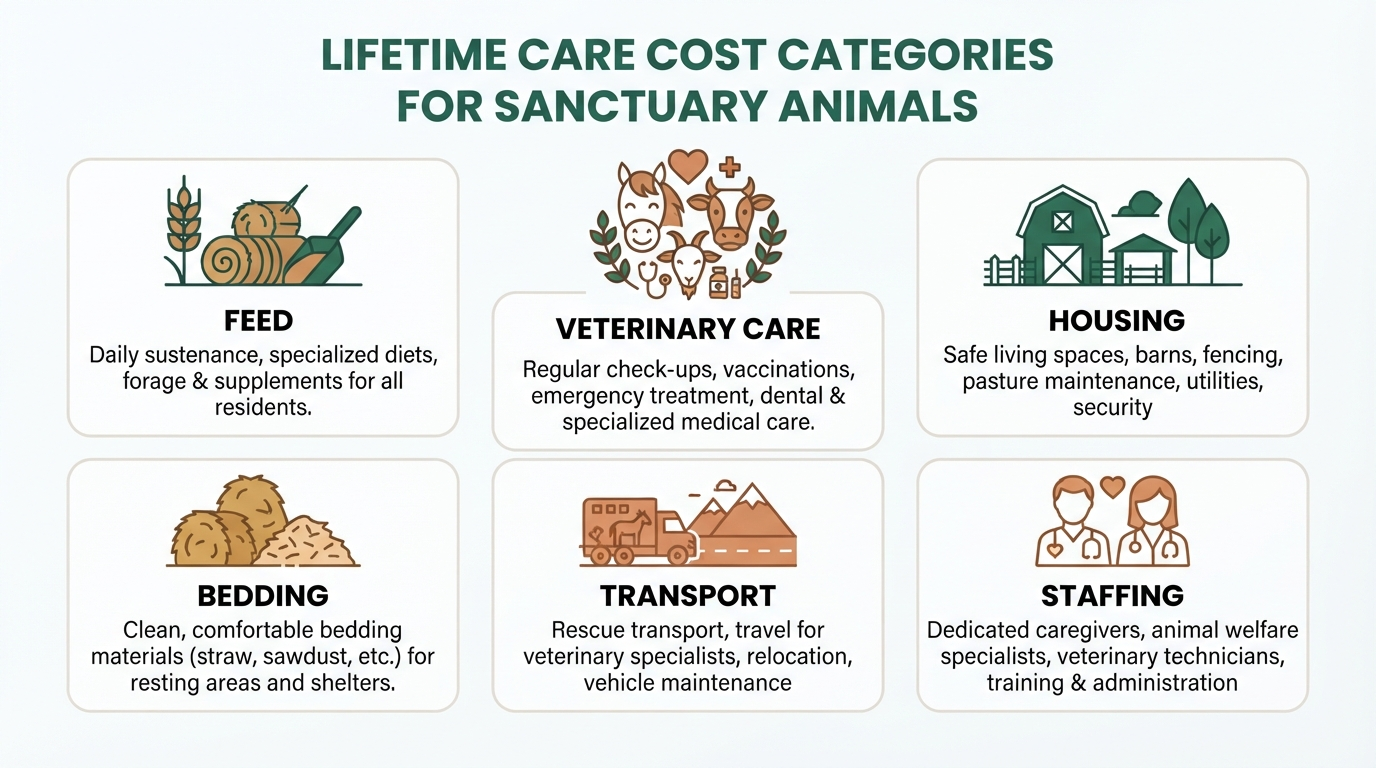
Comprehensive Cost Categories to Track
Lifetime costs cascade across categories. Tally them meticulously:
- Feed and supplements: Daily staples plus vet-recommended boosts.
- Bedding: Absorbent, dust-free materials for hygiene.
- Housing construction/maintenance: USDA-compliant barns, fencing, repairs.
- Routine vet care: Checkups, vaccines, dentistry.
- Emergency vet: Unpredictables like injuries or colic.
- Medications/parasite control: Dewormers, antibiotics as needed.
- Transport/CVI: Vet hauls, health certificates for intakes/transfers.
- Staffing time per species: Hands-on care, monitoring, training.
- Utilities: Water, electricity for heat lamps, pumps.
- Insurance: Liability, property covering residents.
- Waste management: Composting, hauling manure.
- Enrichment: Toys, foraging setups for mental health.
These align with Open Sanctuary Project's holistic view, ensuring nothing slips through.
Your Rescue Cost Estimation Worksheet: A Step-by-Step Framework
Democratize sanctuary financial planning with this simple, data-driven rescue cost estimation worksheet. Use your actuals—no hypotheticals. Here's the framework:
- Gather last year's actuals by category: Pull receipts, ledgers for total spend.
- Allocate to species proportionally: Divide costs by usage (e.g., feed bags per goat).
- Annual per-resident by species: Total species cost ÷ residents that year.
- Average age and remaining years: Average lifespan minus average age.
- Lifetime estimate: Annual cost × remaining years.
- Total obligation: Sum across species.
Worksheet Template
| Species | # Residents (Last Year) | Total Annual Cost (Allocated) | Annual Per-Resident | Avg Age | Avg Lifespan | Remaining Years | Lifetime Per-Resident | Total Lifetime Obligation |
|---|---|---|---|---|---|---|---|---|
| Chickens | [Enter] | [Enter] | [Calc] | [Enter] | [Enter] | [Calc] | [Calc] | [Calc] |
| Goats | [Enter] | [Enter] | [Calc] | [Enter] | [Enter] | [Calc] | [Calc] | [Calc] |
| Grand Total Obligation | [Sum] |
Plug in your numbers; watch realities emerge. For automation, Open Sanctuary Project offers a free calculator at their cost-of-care page—explore more at financial management resources.
Inflation, Contingencies, and Scenario Planning
Static estimates falter against life's curveballs. Adjust annually for inflation across categories. Build a contingency reserve—aim for a percentage buffer covering unknowns like vet spikes.
Scenario Planning: Best, Expected, Stress Cases
Model three paths:
- Best case: Optimal health, low emergencies.
- Expected: Average aging, routine interventions.
- Stress case: Chronic conditions, disasters—factor elder care surges.
This trio sharpens grant writing and board decisions, mirroring NAWN's foster medical plan cost tracking for precise reimbursements.
About NAWN
NAWN (North American Wildlife Network) empowers sanctuaries and rescues with tools for foster medical tracking, grant strategies, and sustainable operations. Integrate this worksheet into your NAWN foster medical plan to streamline cost allocation and boost transparency—turning data into lifelines for more animals.
In the sanctuary world, every calculation is a rescued life. Plan boldly; care eternally.