
AWIC Housing Standards: Humane Guidelines for Primary Enclosures, Enrichment & Shelter Best Practices
Picture a shelter dog stretching fully at dawn, tail wagging in a space that whispers freedom rather than confinement. Or a cat perched on a shelf, eyes alert, weaving through tunnels of her own design. This isn't a luxury—it's the baseline of humane housing standards, as outlined by the USDA National Agricultural Library's Animal Welfare Information Center (AWIC). For shelter managers, rescue operators, and foster families, adhering to AWIC housing guidelines transforms routine care into a foundation for animal well-being, even in resource-strapped environments.
Drawing from the Animal Welfare Act (AWA) regulations in 9 CFR Parts 1-4, AWIC resources emphasize primary enclosure standards that prioritize space, cleanliness, and behavioral needs. These aren't mere checkboxes; they're lifelines preventing stress, injury, and illness. Whether managing a bustling rescue or a foster setup in a suburban home, understanding these benchmarks equips you to elevate animal housing amid limited square footage.
Primary Enclosure Standards: The Core of AWIC Housing
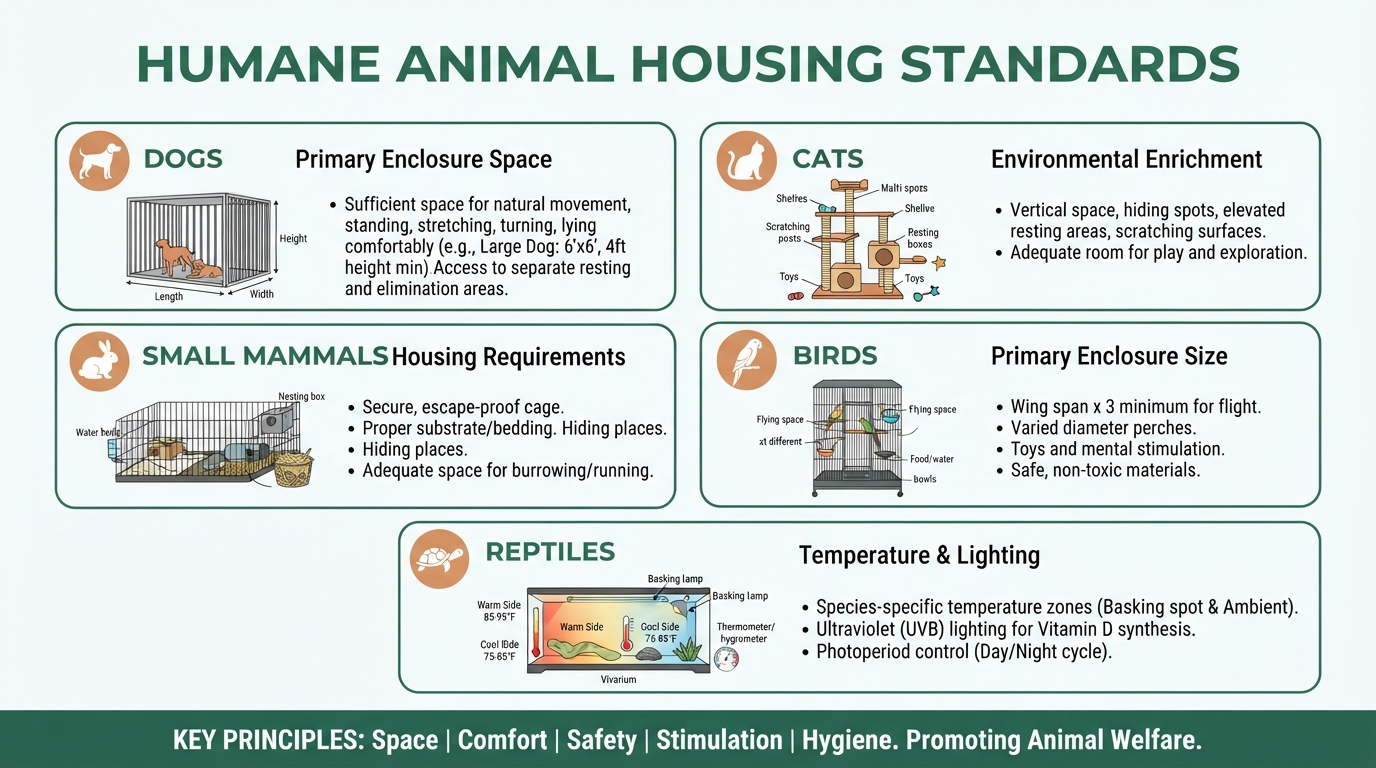
A primary enclosure is the animal's routine living space—kennel, cage, or habitat—designed for safety and comfort. AWIC stresses that it must allow free movement, postural adjustments, and species-typical behaviors. Walls should be sturdy, escape-proof, with smooth, non-porous surfaces for sanitation. Floors? Elevated wire mesh is common for dogs and cats to aid drainage, but solid flooring prevents foot injuries, paired with absorbent bedding.
No sharp edges, protrusions, or toxic materials. For multi-animal setups, dividers ensure compatibility. These basics, per AWIC's AWA compilations, form the scaffold for all shelter standards.
Minimum Space Requirements by Species
Dogs
AWIC guidelines (9 CFR § 3.6) dictate floor space by weight: dogs ≤30 lbs need 8 ft² with 24-inch height; 30-50 lbs require 12 ft² and 30 inches; larger dogs up to 24 ft² and 36 inches. Puppies get proportional scaling, fostering growth without cramping.
Cats
Kittens under 4 months: 1.0-1.5 ft² per; adults 30 in² each up to three per enclosure (total ~3 ft²), with 24-30 inch heights (9 CFR § 3.4). Vertical space reigns supreme here—shelves double utility.
Small Mammals, Birds, and Reptiles
Guinea pigs: 1.5-2 ft² per adult (AWIC small mammal guides). Hamsters: 10-15 in². Birds scale by wingspan/body weight—e.g., finches 0.5 ft², larger parrots 4+ ft² with flight room (9 CFR Subpart C). Reptiles demand secure, escape-proof setups with basking zones, often 2-10x body length in floor space per AWIC reptile care resources.
Indoor vs. Outdoor Housing and Climate Controls
Indoor housing dominates for control: temperatures 60-85°F for most mammals (45°F min for dogs with shelter), 65-85°F for cats and small mammals. Ventilation? 10-15 fresh air changes hourly. Birds and reptiles skew warmer—75-85°F with 40-60% humidity gradients.
Outdoor runs shine for exercise but need weatherproof shelters, windbreaks, and sun shades. AWIC warns against extremes: no housing below 50°F without protection or above 95°F. Lighting mimics nature—12-14 hours daily via windows or LEDs, dimming for restful photoperiods that regulate circadian rhythms.
Sanitation, Pest Control, and Enrichment Essentials
Daily spot-cleaning, full sanitization weekly—using disinfectants safe for animals (9 CFR § 3.11). Pest control? Integrated pest management: seal cracks, monitor traps, avoid poisons near animals.
Environmental enrichment elevates welfare: dogs crave chew toys and scent trails; cats, climbing posts and puzzle feeders; birds, foraging mirrors; reptiles, hides and thermal climbs. AWIC's species-appropriate recommendations reduce stereotypic behaviors like pacing, proven to boost adoptions.
Social housing? Pair compatible animals—dogs walked together, cats in colonies—to curb isolation, but monitor for aggression.
Practical Implementation for Shelters and Foster Homes
Limited space? Stack modular kennels vertically for cats, rotate dogs into communal play yards. Fosters: repurpose closets with PVC pipe towers or laundry baskets as nests. AWIC's flexible interpretations allow creative compliance—e.g., shared outdoor pens cut indoor footprint. Track intake to prioritize: quarantine isolates get solo luxury, social butterflies pair up. Budget tip: donated pallets build custom enrichments, slashing costs while meeting AWIC housing benchmarks.
Actionable Checklist for Housing Self-Assessment
- Measure enclosures: Does floor space meet species/weight minimums per AWIC tables?
- Check climate: Thermometers confirm safe temps/ventilation? Log daily.
- Inspect sanitation: Daily waste removal? Weekly deep cleans? Pest-free?
- Evaluate enrichment: Species-appropriate toys/hides rotated weekly?
- Assess social needs: Compatible pairings? Daily out-of-enclosure time?
- Review lighting: 12-hour cycles? No glare or total dark?
- Emergency prep: Backup heat/power? Evac plans?
Run this quarterly. Non-compliant? Adjust fast—animals notice.
Embracing these humane housing standards isn't just regulation—it's a pact with every wide-eyed arrival. Your diligence ripples: healthier animals, faster adoptions, fuller hearts. Dive into AWIC resources today; the difference unfolds one enclosure at a time.
About NAWN: The National Animal Welfare Network (NAWN) is America's species-neutral animal welfare platform — providing lifetime digital registry, lost-pet recovery, foster coordination, wildlife protection, youth education, and career pathways in animal welfare.