
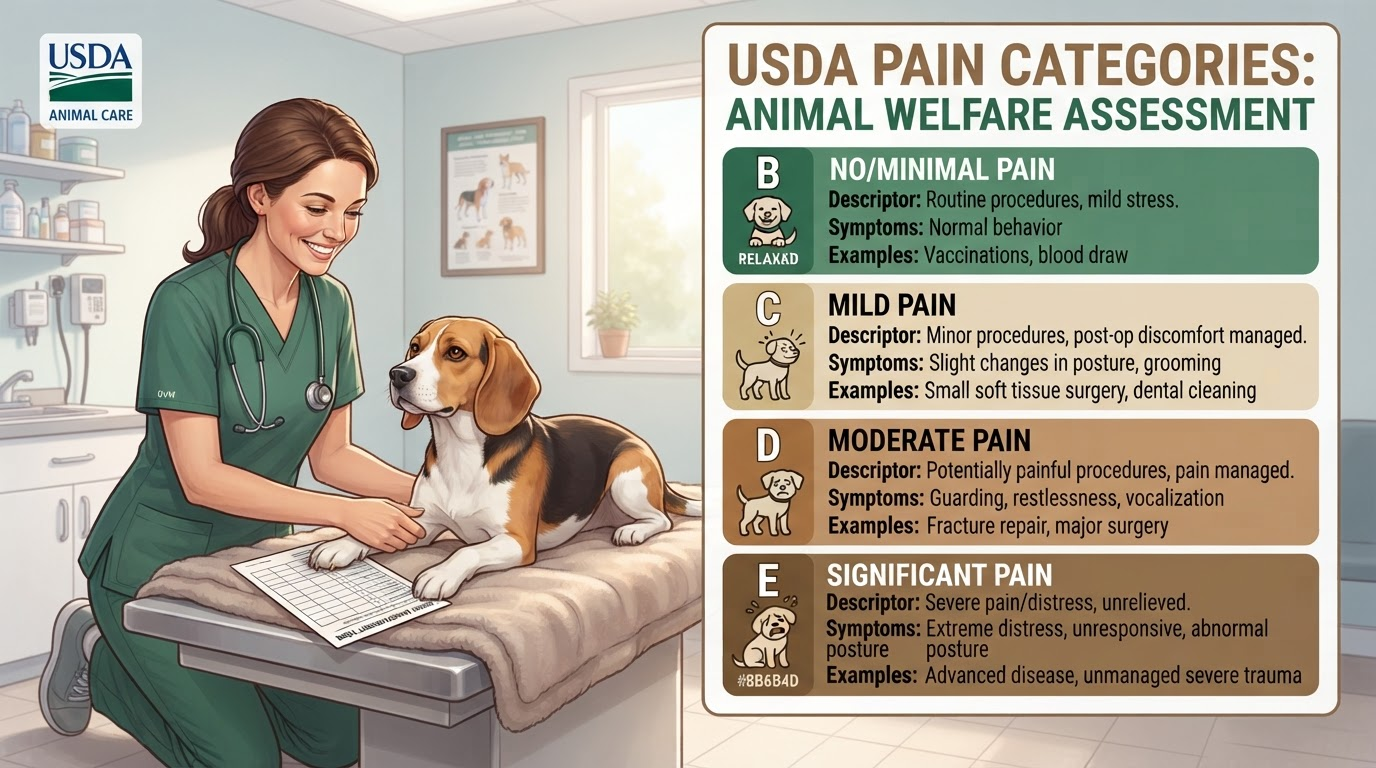
USDA Pain Categories B-E Explained: AWA Reporting & Shelter Pain Scoring Guide
Imagine a shelter dog huddled in the corner, ears pinned back, body tense—a silent cry for help masked by stoic silence. In the high-stakes world of animal welfare, recognizing and categorizing pain isn't just compassionate; it's a regulatory cornerstone and a lifesaving protocol. Enter the USDA pain categories, a framework born from the Animal Welfare Act (AWA) and meticulously detailed by the Animal Welfare Information Center (AWIC) and USDA's Animal and Plant Health Inspection Service (APHIS). These pain distress categories B, C, D, and E guide everything from federally mandated AWA annual reports to voluntary shelter pain scoring, ensuring veterinary welfare standards elevate care across settings.
Designed originally for research facilities, these categories compel transparency in how animals experience discomfort during procedures or housing. For shelter veterinary staff, rescue medical coordinators, and animal welfare auditors, mastering them unlocks precise AWIC pain assessment tools adaptable to chaotic rescue environments—where every limp or flinch demands swift, documented action.
The Four USDA Pain Categories Explained
APHIS defines these categories to classify animal activities based on pain or distress levels and intervention. Category A—minimal pain or distress not requiring drugs—is often excluded from deeper scrutiny, shifting focus to B-E for nuanced USDA pain categories analysis.
Category B: Breeding, Conditioning, or Holding
The baseline: animals involved solely in breeding, conditioning, or standard holding. No painful procedures occur, and distress is absent or negligible. Think routine shelter intake—healthy strays acclimating without intervention. Per APHIS guidelines via AWIC, these represent welfare's steady state, demanding vigilant monitoring to prevent escalation.
Category C: No Pain, Distress, or Use of Pain-Relieving Drugs
Here, procedures like blood draws or imaging induce no more than momentary distress, with no analgesics needed. Animals recover swiftly, exhibiting normal behaviors. In shelters, this mirrors minor exams or vaccinations—efficient care without red flags.
Category D: Pain or Distress With Pain-Relieving Drugs
Pain occurs, but it's managed: think post-surgical recovery with opioids or NSAIDs administered per protocol. Documentation proves relief aligns with veterinary standards, a critical pivot for shelter pain scoring where injured rescues thrive under medicated care.
Category E: Pain or Distress Without Pain-Relieving Drugs
The ethical red line: unrelieved pain justified only by scientific necessity (rare in shelters). Behaviors scream distress—prolonged vocalization, refusal to eat. AWIC emphasizes this category's rarity, urging immediate review to avoid welfare violations.
How Pain Categories Are Used in AWA Annual Reporting
Registrants submit APHIS Form 7023 annually, tallying animals by USDA pain categories. Category B sets the volume baseline; C-E detail interventions. Protocols undergo Institutional Animal Care and Use Committee (IACUC) review, with records proving compliance—no vague logs, but specifics on drugs, durations, and rationales. Auditors scrutinize E-category justifications, ensuring AWA annual report integrity. This rigor, per USDA APHIS technical notes, fosters accountability.
Adapting Pain Assessment for Shelter and Rescue Settings
Shelters dodge AWA reporting mandates, yet embracing pain distress categories B C D E revolutionizes operations. Standardized shelter pain scoring flags at-risk animals early, streamlines triage, and bolsters grant applications showcasing veterinary welfare excellence. A limping cat in Category D gets analgesics faster; a Category E bird prompts euthanasia review. AWIC resources empower non-researchers, turning federal standards into everyday shields against suffering.
Practical Pain Scoring Systems
Translate categories into action with grimace scales and behaviors. Species-neutral cues include withdrawal from touch, guarding wounds, or lethargy. Tailor by species:
- Dogs: Grimace scale scores orbital tightening, ear flattening; add tail tucking, whining.
- Cats: Hunched posture, dilated pupils, hissing—subtle agony demands quiet observation.
- Rabbits: Teeth grinding, slumped posture; porphyrin staining around eyes signals distress.
- Birds: Fluffed feathers, beak grinding, drooped wings—monitor perch use closely.
Score 0-2 per facial/behavioral cue (e.g., Mouse/Equine Grimace Scales adapted), aggregating for category assignment.
When Veterinary Intervention Is Required and Documentation Standards
Escalate at Category D/E thresholds: unrelieved scores above mild, or behaviors persisting 24 hours. Vet consults cover imaging, surgery, or humane endpoints. Document via timestamps, scores, drugs (dose/route), and photos—mirroring AWA rigor. AWIC stresses chain-of-custody logs for audits.
Practical Pain Assessment Checklist for Shelter Staff
- Observe undisturbed for 5+ minutes: note posture, gait, interactions.
- Score grimace/behaviors (0=none, 1=mild, 2=obvious): face, body, activity.
- Assign USDA category: B (normal), C (minimal), D (relieved), E (unrelieved).
- Palpate gently: record flinch responses.
- Check vitals: HR, RR, temp deviations signal escalation.
- Offer food/water: appetite loss ups score.
- Administer analgesics if D; re-score in 1-2 hours.
- Document digitally: date, score, actions, signee.
- Alert vet for scores >4/10 or E indicators.
- Review daily: trend toward improvement or humane endpoint.
Source: Adapted from USDA APHIS Pain Categories technical note via AWIC.
In the quiet urgency of shelters, these USDA pain categories bridge regulation and reality—transforming observations into lifelines. Equip your team, audit your protocols, and watch welfare soar.
About NAWN: The National Animal Welfare Network (NAWN) is America's species-neutral animal welfare platform — providing lifetime digital registry, lost-pet recovery, foster coordination, wildlife protection, youth education, and career pathways in animal welfare.