
ADA Rules Explained: Essential Compliance Guide for Accessibility Success
Imagine stepping into a bustling coffee shop, your service dog at your side, only to face a manager's skeptical glare and a pointed question: "Is that really a service animal?" Moments like these underscore why mastering ADA rules isn't just legal homework—it's the key to seamless access and dignity for handlers everywhere.
The Americans with Disabilities Act (ADA) has empowered millions since 1990, mandating equal access in public spaces. For handlers—those vital partners guiding service animals through daily challenges—these rules form a lifeline. This guide demystifies ADA rules, zeroing in on service animal regulations to equip you with confidence and clarity.
Core ADA Rules: What Handlers Need to Know
At its heart, the ADA prohibits discrimination against people with disabilities, including those relying on service animals. Public accommodations—from restaurants to retail stores—must allow service animals without extra fees or special permissions. Handlers bear the responsibility of ensuring their animal is well-behaved, but businesses can't demand invasive proof.
Defining a Service Animal Under ADA Rules
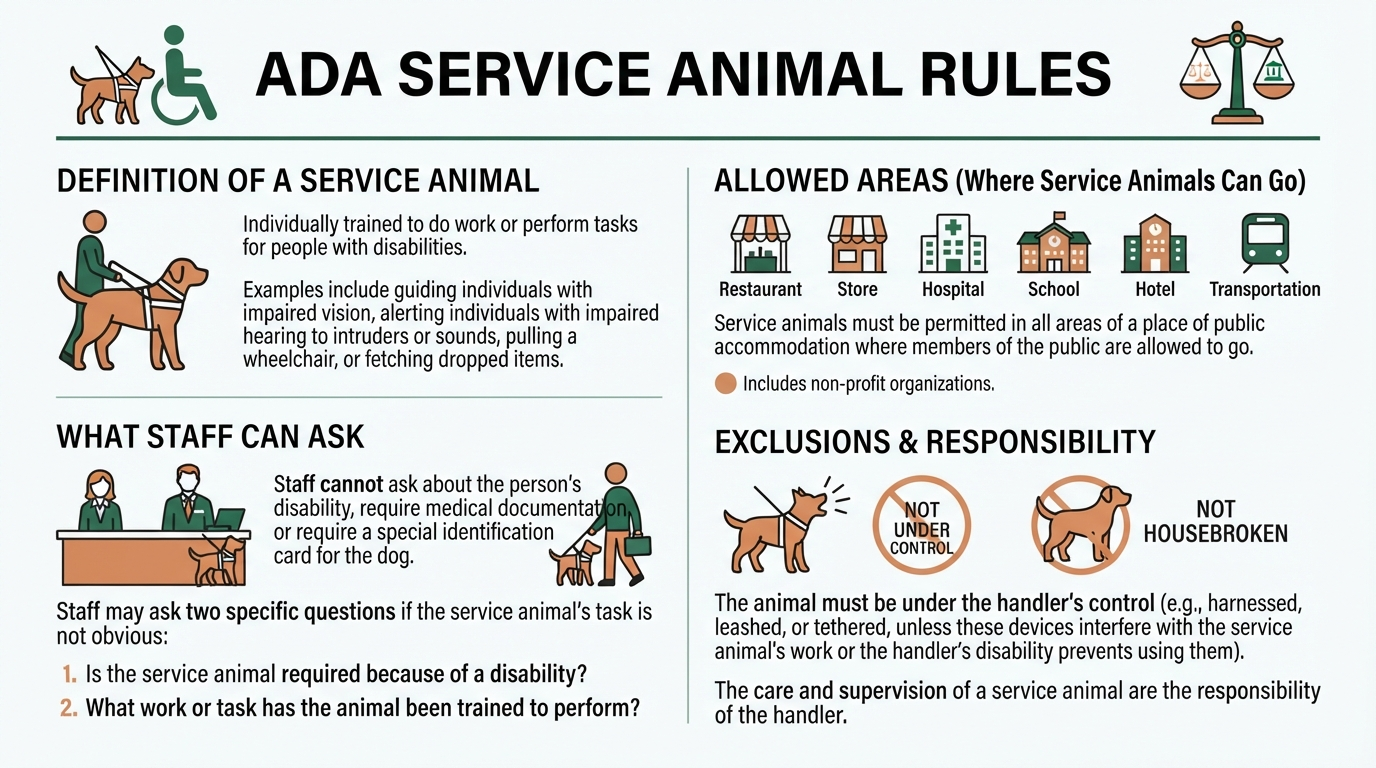
Not every pet qualifies. ADA rules define service animals narrowly: dogs (or miniature horses in rare cases) individually trained to perform tasks for a person's disability. Emotional support animals? They don't count here—only task-trained companions do.
- Tasks like retrieving items, alerting to seizures, or guiding the visually impaired.
- No certification required; staff can only ask two questions: (1) Is it a service animal required for a disability? (2) What task does it perform?
- No demos, vests, or papers needed—behavior speaks volumes.
Service Animal Regulations: Handler Best Practices
Compliance flows both ways. Handlers must keep service animals under control, leashed or harnessed unless it interferes with work. Clean up waste, and exit if the animal poses a direct threat—like uncontrollable barking or aggression.
Navigating Common Challenges
Airlines follow different DOT rules, allowing trained animals in cabins. Housing under FHA permits assistance animals beyond ADA scope. Misunderstandings arise—train your team with ADA resources from justice.gov to preempt issues.
- Prep with ID cards (voluntary but helpful).
- Practice public manners rigorously.
- Know your rights: Politely educate, escalate to management if denied.
ADA rules aren't barriers—they're bridges to independence, turning potential conflicts into cooperative access.
Achieving Accessibility Success
Stay updated via official ADA sites, as rules evolve. Handlers who embody these principles not only comply but inspire—proving service animals transform lives without disruption. Embrace ADA rules as your toolkit for empowered journeys.
About NAWN: The National Animal Welfare Network (NAWN) is America's species-neutral animal welfare platform — providing lifetime digital registry, lost-pet recovery, foster coordination, wildlife protection, youth education, and career pathways in animal welfare.