
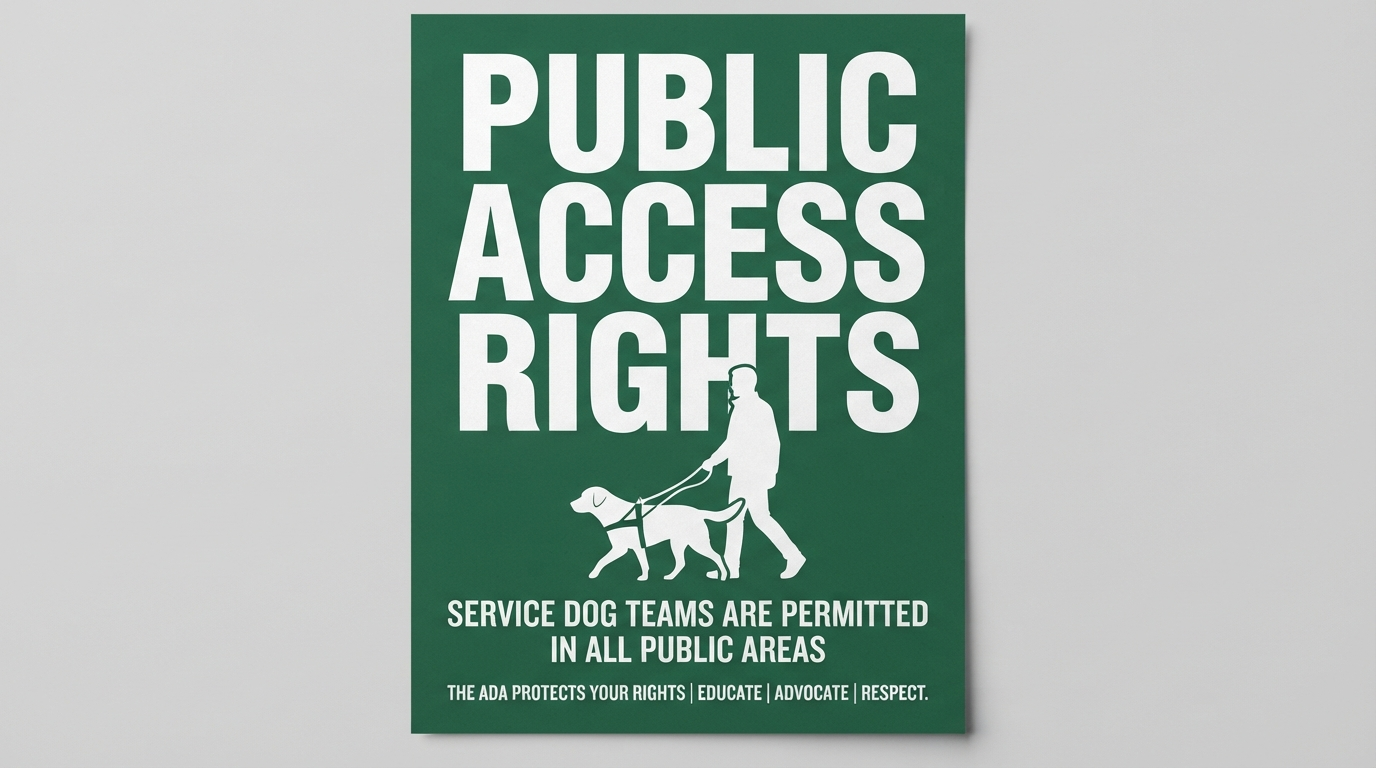
Service Animal Public Access Rights: ADA Rules for Businesses and Handlers
Picture this: you push open the door to your favorite coffee shop, your service dog steady at your heel, eyes alert and harness secure. The barista glances down, frowns, and says, "Sorry, no pets allowed." Your heart sinks. Moments like these highlight the real-world stakes of service animal public access. Yet under the Americans with Disabilities Act (ADA), such denials violate federal law. This guide unpacks ADA public accommodation rules, empowering handlers and clarifying duties for business owners.
Defining Places of Public Accommodation Under the ADA
The ADA's Title III governs service animal public access in places of public accommodation. These span a wide array: hotels, restaurants, retail stores, theaters, banks, medical offices, parks, and more. Any facility whose operations affect commerce and offers goods or services to the public falls under this umbrella. Grocery stores bustling with shoppers? Covered. Quiet libraries? Absolutely. The law ensures equal access for individuals with disabilities who rely on service animals, primarily dogs trained to perform tasks mitigating disabilities.
Business owners must modify policies to permit service dogs, unless it fundamentally alters the business or poses a direct threat. No pet policies bend here, but emotional support animals do not qualify.
Businesses Required to Allow Service Animals and Key Exceptions
Who Must Comply?
Virtually all public-facing businesses qualify. From boutique shops to large chains, if customers enter, service dog access rights apply. Staff may ask two questions only: (1) Is this a service animal required because of a disability? (2) What work or task has it been trained to perform? No proof demanded. No origin stories required.
Notable Exceptions
- Religious organizations: Entities primarily engaged in religious activities, like churches conducting worship services, are exempt from ADA public accommodation rules.
- Private clubs: Nonprofits with selective membership that do not operate for profit are outside ADA scope. Think exclusive social clubs, not open-to-all gyms.
These carve-outs protect specific private spheres, but most businesses remain obligated.
What to Do When Denied Service Animal Public Access
Denial stings, but respond with poise. First, stay calm and assert your rights politely: "Under the ADA, this is a service animal allowed in places of public accommodation." Offer to answer the two permitted questions. Request the manager if needed. If access remains blocked, note details: time, staff names, reason given.
Educate Respectfully
Knowledge disarms ignorance. Share a simple fact sheet or ADA summary. Frame it as partnership: "I appreciate your concern for hygiene; service animals are trained and healthy." Compassion builds bridges, turning skeptics into allies.
Helpful Documentation (Not Required)
The ADA demands no papers, vests, or certifications. Yet carrying voluntary ID cards, training logs, or handler letters from trainers can smooth interactions, especially with well-meaning but uninformed staff.
Beyond Federal Rules: State Laws and Filing Complaints
Many states bolster ADA protections, expanding service animal public access to taxis, housing, or miniature horses. Check your state's attorney general site for specifics. For violations, file a complaint with the U.S. Department of Justice (DOJ) online or via 800-514-0301. No cost, no lawyer needed. DOJ investigates patterns or mediates resolutions, upholding service dog access rights nationwide.
Armed with these tools, handlers gain confidence, and businesses foster inclusivity. Access is not a privilege; it is a right woven into America's fabric.
About NAWN: The National Animal Welfare Network (NAWN) is America's species-neutral animal welfare platform - providing lifetime digital registry, lost-pet recovery, foster coordination, wildlife protection, youth education, and career pathways in animal welfare.