
Ultimate Guide to Animal Welfare Assessments: Five Freedoms, SWAP, ASPCA Shelter Rounds & AWIN Indicators
Imagine stepping into a shelter where every animal's eyes meet yours with quiet confidence rather than fear. That's the power of rigorous animal welfare assessment—not just a checklist, but a lifeline transforming chaotic rescues into havens of health and happiness. For shelter directors, auditors, quality assurance staff, and rescue evaluators, mastering these evaluations isn't optional; it's the cornerstone of ethical operations and donor confidence. Drawing from the AWIC welfare assessment framework at the USDA National Agricultural Library Animal Welfare Information Center, this guide unpacks the Five Freedoms as your baseline, dives into proven tools like the Shelter Welfare Assessment Protocol (SWAP), ASPCA Shelter Rounds, and AWIN welfare indicators, and equips you with actionable strategies for audits, self-assessments, and continuous improvement.
The Five Freedoms: The Bedrock of Animal Welfare Assessment
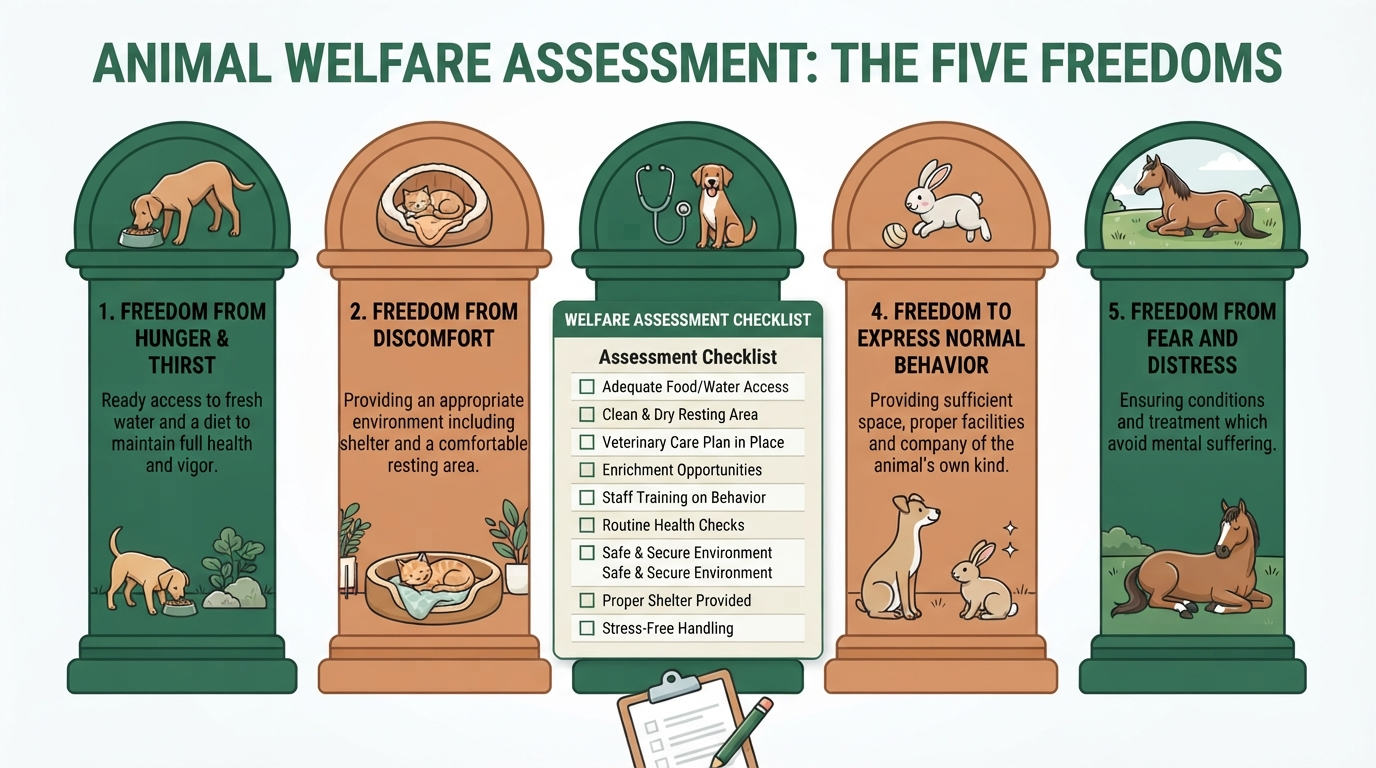
Since their inception in 1965 by the UK's Farm Animal Welfare Council, the Five Freedoms have stood as the gold standard for animal welfare assessment. They provide a simple yet profound framework: freedom from hunger and thirst; discomfort; pain, injury, or disease; fear and distress; and to express normal behaviors. In shelters, these translate to tangible checks—ensuring constant access to fresh water, comfortable bedding, prompt veterinary care, low-stress environments, and space for natural movements like stretching or rooting.
Auditors zero in here first. A dog pacing endlessly in a barren kennel? That's a red flag on behavioral freedoms. The AWIC emphasizes integrating these freedoms into every protocol, making them the lens through which all other tools shine.
Essential Tools for Robust Animal Welfare Assessments
Shelter Welfare Assessment Protocol (SWAP)
Developed by shelter experts, the Shelter Welfare Assessment Protocol (SWAP) offers a comprehensive, species-neutral scorecard. It evaluates housing quality, nutrition, health, and behavior across populations, using metrics like cleanliness scores and population density. Picture scoring a cat's enclosure on ventilation, litter provision, and play opportunities—SWAP turns subjective observations into data-driven insights, ideal for benchmarking against peers.
ASPCA Shelter Rounds
The ASPCA Shelter Rounds protocol streamlines daily welfare checks with a rounds-based approach. Staff conduct structured walkthroughs, noting body condition, lameness, or aggression cues. It's practical for high-volume shelters: a quick app or clipboard scan flags issues like overgrown nails or empty food bowls, preventing escalation. AWIC resources highlight its role in proactive care.
AWIN Welfare Indicators
The AWIN welfare indicators, from the Animal Welfare Indicators project, deliver science-backed protocols for on-farm and shelter use. These include quantitative measures like body condition scoring (BCS) on a 1-9 scale, lesion counts, and human-animal interaction tests. For a rabbit hutch, auditors might tally fecal soiling or assess ear cleanliness—precise, repeatable, and aligned with Five Freedoms outcomes.
What Auditors Really Look For in Animal Welfare Assessments
Auditors scrutinize body condition scoring first—emaciated frames or obesity signal nutritional gaps. Behavior logs reveal chronic stress: withdrawn postures in birds or excessive barking in packs. Housing audits probe for hygiene, temperature control, and escape-proofing, while health records demand vaccination histories and spay/neuter rates. Enrichment logs prove intent—scatter-feed toys for ferrets, climb structures for primates. Miss these, and even stellar intentions falter.
- Body condition: Visual and hands-on BCS for every animal.
- Behavior: Scan sampling for play, rest, and social dynamics.
- Housing: Square footage per animal, waste removal frequency.
- Health records: Treatment timelines, quarantine compliance.
- Enrichment: Documented logs of toys, scents, and rotations.
Self-Assessment Tools for Small Rescues with Limited Resources
Resource-strapped rescues don't need fancy tech. Start with simplified Five Freedoms checklists from AWIC—weekly rounds noting water bowls and clean bedding. Adapt SWAP lite versions: score 20% of animals monthly. Free ASPCA templates offer printable rounds sheets; AWIN provides open-access BCS charts. Pair with phone photos timestamped for trends. Consistency beats perfection, building a welfare baseline without breaking the bank.
From Assessment to Action: Crafting Improvement Plans with SMART Goals
Raw scores mean little without plans. Analyze SWAP data: if 30% of dogs show poor BCS, set a SMART goal—Specific (daily weigh-ins), Measurable (target 20% improvement), Achievable (staff training), Relevant (ties to nutrition freedom), Time-bound (quarterly review). Track via spreadsheets or apps, revisiting ASPCA Rounds to validate progress. This cycle fosters a culture of accountability.
Public Transparency and Welfare Reporting for Donor Trust
Donors demand proof. Share anonymized AWIN scores or SWAP summaries on websites—'85% of animals met full Five Freedoms this quarter.' Annual reports with charts build trust, mirroring accredited programs. Transparency isn't vulnerability; it's a magnet for support.
How NAWN's Platform Elevates Welfare Tracking and Transparency
NAWN streamlines this with MedicalRecord for digital health logs, a lifetime registry for outcome tracking, and verification tools for audit-proof records. Log enrichment via foster coordination modules; generate reports tying assessments to lost-pet recovery and wildlife data. It's species-neutral scalability for every shelter size.
Audit Prep Checklist: Your Roadmap to Excellence
- Compile 6 months of health records and enrichment logs.
- Conduct mock SWAP/ASPCA Rounds; score honestly.
- Train staff on BCS and AWIN protocols.
- Organize housing for easy visual audits.
- Prepare SMART action plans from past data.
- Run a full Five Freedoms walkthrough.
- Backup digital records in NAWN or cloud.
With this arsenal, your shelter doesn't just pass audits—it leads in welfare. Elevate standards, inspire teams, and watch animals thrive.
About NAWN: The National Animal Welfare Network (NAWN) is America's species-neutral animal welfare platform — providing lifetime digital registry, lost-pet recovery, foster coordination, wildlife protection, youth education, and career pathways in animal welfare.