
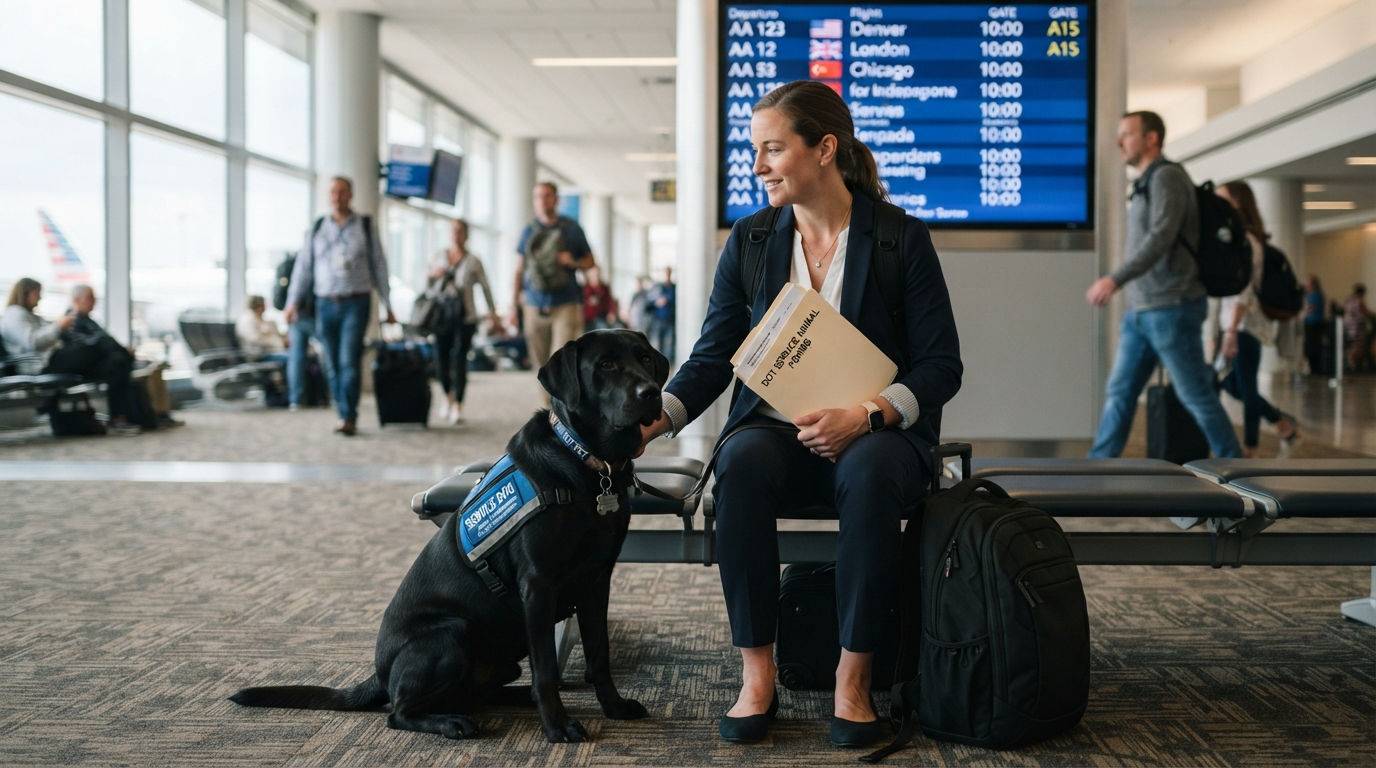
Service Animal Air Travel: DOT Rules, Forms & Airline Requirements Post-2021
Picture this: You approach the gate with your service dog at your side, leash in hand, tickets confirmed. Yet the agent hesitates, form in question. Confusion at 30,000 feet is the last thing any handler needs. Since 2021, the U.S. Department of Transportation (DOT) has clarified service animal air travel rules under the Air Carrier Access Act (ACAA). These changes prioritize safety while protecting legitimate needs. Emotional support animals no longer qualify. Only trained dogs count as service animals. This guide breaks down DOT service animal rules, required forms, and airline policies for smooth journeys.
DOT Service Animal Definition After 2021 Changes
Post-2021, DOT defines a service animal strictly as a dog trained to perform specific tasks for a person's disability. Miniature horses may qualify in rare cases if they meet rigorous standards. No other species fly free as service animals. Airlines verify training through documentation. This shift ended cabin chaos from untrained pets. Handlers must prove the dog works or tasks directly related to the disability, like alerting to seizures or retrieving items.
Service animal air travel demands preparation. Airlines enforce these rules uniformly, closing loopholes that once allowed peacocks and rabbits aboard.
Required DOT Forms: Submit 48 Hours Before Flight
The DOT Service Animal Air Transportation Form
Core to DOT service animal rules is the DOT Service Animal Air Transportation Form. Submit it digitally or in person at least 48 hours before departure. It attests your dog is trained, vaccinated, healthy, and trained not to relieve itself inappropriately except in designated areas. Download from DOT's site. Airlines cannot board without it for advance reservations.
Relief Attestation for Flights Over 8 Hours
For flights exceeding eight hours, add the Relief Attestation Form. Confirm your airline service dog can either refrain from relieving itself or do so in a way that avoids health hazards. No container required, but proof matters. Last-minute bookings waive forms if you lack 48 hours, but expect extra scrutiny.
What Airlines Can Ask and Require
Airlines verify credentials without invasive questions. They can request DOT forms and observe behavior. No health exams or proof of specific tasks allowed. Your dog must fit at your feet, under seat, or lap. Leash or harness required unless it interferes with work. Airlines deny if the animal poses a direct threat or disrupts safety.
- Check vaccination records indirectly via forms.
- Observe calm demeanor pre-boarding.
- Confirm no excessive noise or aggression.
Animal Behavior Standards and Seating Restrictions
Onboard, your service dog must behave impeccably. No growling, jumping, or blocking aisles. Airlines remove disruptive animals. Seating bans exit rows, bulkheads if they obstruct. Choose wisely during booking to accommodate space.
International Service Animal Air Travel Considerations
Flying abroad? DOT rules apply to U.S. carriers. Foreign airlines follow local laws. Secure import permits, rabies titers, health certificates weeks ahead. Countries like the UK demand microchips and quarantine proof. Research destinations early.
Denied Boarding? Steps to Take
If denied, stay calm. Ask for the policy cited. Request a supervisor. Document everything. File a DOT complaint online within six months at DOT's portal. Seek airline customer service resolution first. Legal aid via disability rights groups can escalate.
Armed with DOT service animal rules and forms, your next flight awaits without turbulence. Safe travels with your partner.
About NAWN: The National Animal Welfare Network (NAWN) is America's species-neutral animal welfare platform - providing lifetime digital registry, lost-pet recovery, foster coordination, wildlife protection, youth education, and career pathways in animal welfare.